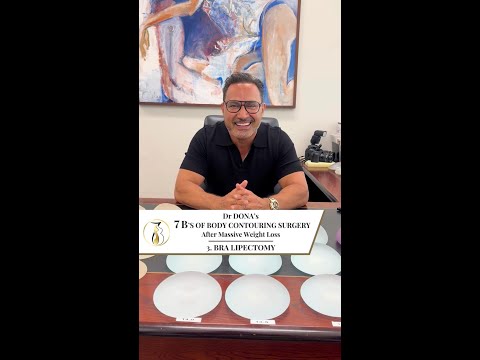
An Upper Body Lift or Bra Lipectomy is an operation that addresses excess skin rolls and associated fat in the upper and middle part of the back and around the bra strap area. Typically, the procedure is performed on individuals who have experienced significant weight loss.
A Bra Lipectomy would typically involve a scar at the level of a bra strap that is circumferential, or near circumferential.
A BUTTOCK LIFT (Gluteal Lipectomy) describes a surgical procedure that involves the removal of excess skin from the lower back, lifting and tighteneng the buttocks. If combined with an Abdominoplasty (aka Tummy Tuck) …
Learn moreIf you’ve lost a considerable amount of weight or have excessive loose skin that’s lost elasticity, you may be wondering which type of thigh lift is for you. The descriptions of the four types of Thigh Lifts below may…
Learn moreA Brachioplasty procedure is performed in a private hospital under general anaesthesia. Depending on the procedure required, your surgery may take between two and four hours. Dr Dona performs several types of Arm Lift…
Learn moreIn plastic surgery, a ‘Belt Lipectomy’ is also sometimes referred to as a ‘Total Body Lift’, ‘Lower Body Lift’ or a ‘Lower Truncoplasty’. Ultimately, the name is not that tcritical, but your surgeon’s explanation as t…
Learn moreThe displayed before and after pictures are provided as an educational tool to demonstrate some of the results achievable from plastic surgery. All surgeries are performed by Dr Eddy Dona and are published with the written consent of the patients.
Speak with Dr Eddy Dona about your suitability, the surgical options, recovery and costs. Our friendly team will call you back to discuss the procedure and schedule your appointment.

A general guide to recovery. Individual recovery varies and your personalised schedule will be provided before surgery.
After excessive weight loss, some areas of the body can cause more problems than others, but usually, there are several areas of concern. When reconstructing the upper body area, Dr Dona must tailor the surgery (and create the necessary incisions) to address the patient's specific concerns. When determining the surgical pattern for your concerns, Dr Dona will assess the following: The back: upper, mid and lower Sides of the chest wall and underarm region Upper abdominal wall and lower chest region By thoroughly assessing these areas, Dr Dona can create the optimal surgical plan (with the associated scar patterns) to achieve a positive functional and aesthetic outcome. He will discuss this surgical plan in detail with you during your Initial Consultation. Potential scar patterns include scars that: run along the bra line, in the upper back region extends from the back to the sides of the chest extends from the back to the upper abdominal wall along the lower breast fold — a fully (or near) circumferential scar pattern
When you wake from surgery, the head of your bed will be elevated and a pillow will be placed under your knees to maximise your comfort. You’ll have drains placed in your back region, which exit from the outer mid torso region. You’ll also have been fitted with a compression garment around your torso to help minimise swelling, reduce tension in the wounds and aid in healing. You’ll have a catheter placed in your bladder. This will allow you to stay relaxed in bed without having to go to the toilet. The catheter is usually removed a day or two post-surgery, while in the hospital. You’ll also have at least one drip in place to give you IV fluids, pain medication and antibiotics. To help prevent DVT, you’ll have special massage devices on both legs. These are designed to minimise the chance of any blood clots developing by promoting blood flow. Waterproof dressing will cover your wounds. This will stay in place until you arrive at our clinic for your first HeaLED post-op appointment. During this time, your dressing will be removed, the areas will be treated with LED light and micropore tape will be applied to your incisions. Micropore tape will be taken on and off in between appoin…
Showering: You’ll be allowed to shower with assistance while in hospital. Surgery incisions need to be kept dry for one week post-surgery. Physiotherapy: A physiotherapist will see you on the first day after surgery. This is so they can help you get out of bed and start to mobilise gently. The sooner you get out of bed after surgery, the better. Pain and discomfort: You may feel discomfort, along with shooting pains or a burning sensation. However, these sensations are usually associated with your drains, and this pain usually goes away. Numbness and tingling sensations will also typically diminish. However, in some cases, numbness can persist. This can occur with any scar or surgical site. Bloating and constipation: These are common side effects after surgery, due to your strong pain medications and lack of activity — both of which slow down the bowel. To counteract this, you’ll be given a constipation medication called Movical. You’ll start taking this while in hospital, but you may wish to continue with it for a few days when you return home. Discharge medications: Discharge medications are standard for all patients. These typically include pain medication, blood thinners an…
Immediately after surgery, you’ll be fitted with compression garments. These garments/tights play a vital role in controlling swelling and helping with the healing process. You must wear these compression garments for at least six weeks. You can expect parts of your body to be very swollen initially; however, most of this will disappear over the first few weeks. You may also notice that the amount of swelling differs from one side to the other, but this is normal and nothing to worry about. Some people may benefit from wearing compression garments for many months after surgery to control residual swelling.
Every surgical procedure carries potential risks and complications. It’s important to be aware of these before making any decisions about surgery.
To find out more about the potential risks and complications related to surgery, please go here >
Specific potential complications may include:
A simple analogy to help explain why patients may require more than one operation is dressmaking. With dressmaking, once sewn, you often need a second fitting to make minor adjustments and ensure it fits just right.
Bra Lipectomy surgery is, of course, many times more complex than dressmaking. The skin and tissues are not static and rigid objects; they swell, stretch, shrink, sag, and so on. Additionally, the underlying body is also changing.
As a surgeon, Dr Dona is reconstructing everything in all three dimensions, while ensuring that he tightens the issues adequately while not making the tissues too tight, thereby increasing the risk of wound complications.
With this in mind, after everything settles, and things ‘relax’ into position, it’s normal for things to be nowhere near as tight as they were straight after surgery. Therefore, it’s not uncommon for patients to require further surgery to ’fine-tune’ the results, just like you would for a second fitting of a tailor-made dress. This is especially true in large reconstructions.
Therefore, we recommend that you should not undertake any surgery, especially larger surgeries, if you are not prepared to have further surgery and the associated time off and costs involved.
A suitable candidate for Bra Lipectomy surgery is typically someone who has undergone significant weight loss and is left with excess skin on their upper body. Suitable candidates should also be in good mental and physical health, understand the potential risks and complications of surgery and have realistic expectations regarding their surgical outcomes.
Everyone has a different experience with pain after surgery. Some experience only mild discomfort, while others have significant pain. You’ll likely experience localised pain at your incision sites, but also nerve pain (shooting pains and burning). However, your specialist anaesthetist will provide you with pain medication to help with any discomfort while you’re in hospital. They will also give you medications to take home with you. Additionally, you’ll commence your HeaLED Light Therapy the day after you leave hospital, which will help minimise swelling, inflammation and pain.
Most patients spend at least two nights in a private hospital before they are medically fit to return home. Other patients may benefit from staying another couple of days, or even up to a week in hospital, before they feel confident to go home.
When you return home, you’ll be encouraged to move around as much as possible. However, you must listen to your body and only move around to the extent that you’re comfortable with.
We recommend you have someone with you at home for at least the first week to help with general day-to-day care.
You’ll be placed in a compression garment immediately after your surgery. This helps to manage your swelling. You must wear your compression garment for at least six weeks. You can expect to see a significant reduction in the initial swelling within the first two weeks following your surgery.
You’ll also commence your HeaLED Light Therapy the day after you leave hospital, which will greatly help minimise swelling, inflammation and pain.
Also, it’s not uncommon to see a slight difference in swelling from one side to the other.
No set sleeping position is advised following your surgery. You can sleep in any position that you’re most comfortable in. However, you may find that sleeping on your back is the most comfortable for the first few weeks.
You should not consider driving for the first two weeks after surgery. After this time, you should only drive if you feel safe doing so.
Do not immerse yourself in water, which includes bathing or swimming until at least three weeks following your surgery.
After approximately two weeks post-surgery, you can consider returning to light office or desk work. After four weeks, light hospitality work may be possible. Any job that involves heavy lifting or straining must be avoided for six weeks.
Six weeks after your operation, you can gradually return to regular gym training and physical activities. Think of the first six weeks after your surgery as recovery and the following six weeks of activities as rehabilitation. You can perform any physical activities that you’d like, but be guided by your comfort levels and strength, and remember, you will slowly improve over time.
You can return to sexual activity at any stage with the following understanding:
It will take at least six months before you’re feeling ‘normal’ and able to do all the things you could before surgery. At this stage, we’ll also assess your final surgical results. However, be aware that your scars may take up to 24 months to mature.
Speak with Dr Eddy Dona about your suitability, the surgical options, recovery and costs. Our friendly team will call you back to discuss the procedure and schedule your appointment.
Complete the form and our team will be in touch within one business day.